
Fireproof Aluminum Composite Panel: Core Types, Fire Ratings, Standards And How To Specify A Compliant Facade
Nov 20, 2026
A fireproof aluminum composite panel (fire rated ACP or FR ACM) is an aluminium sandwich panel whose polyethylene core is replaced or heavily filled with non-combustible mineral content - typically aluminium trihydrate and magnesium hydroxide - so that it limits flame spread, heat release and smoke. Standard LDPE-core ACP is combustible and restricted to low-rise and signage use; FR cores with roughly 70% mineral filler serve mid-rise commercial facades; A2 cores with over 90% inorganic content are specified for high-rise, tunnel, airport and public buildings. The fire rating comes from the core and the tested wall assembly, never from the coating.
Key Takeaways
Core, not coating
PVDF or PE changes weatherability only. Fire classification is determined by mineral content in the core and by the complete assembly test.
Three tiers
LDPE (combustible), FR / B1 (about 70% mineral filler) and A2 (over 90% inorganic) cover almost every specification in the market.
E84 is not NFPA 285
ASTM E84 Class A measures surface burning of a material. Multi-storey exterior walls require an NFPA 285 assembly test.
Test the exact build-up
Certificates must match the skin thickness, core, coating, insulation, cavity barrier and fixing system actually being purchased.
Mineral cores fabricate differently
A2 panels are stiffer, less tolerant of tight V-groove folding, and need sealed edges to keep moisture out of the filler.
Documentation is the product
A credible China supplier provides EN 13501-1 classification, fire-resistant test reports, CE / SGS / CTC documents and batch traceability.
In This Guide
- What "fireproof ACP" actually means
- LDPE, FR and A2 cores explained
- Fire test standards decoded
- Why the whole wall assembly is tested
- Matching the core to the building type
- Fireproof ACP in the Jixiang product range
- Fabrication and installation differences
- How to verify certificates and traceability
- Price drivers and factory-direct procurement
- Frequently asked questions
1. What "Fireproof ACP" Actually Means
The phrase is convenient but imprecise. An aluminum composite panel is a composite of two aluminium skins and a polymer or mineral core; the aluminium skins themselves are non-combustible in the usual classification sense but will soften and melt under sustained fire, and the adhesive film and any coating are organic. No ACP is literally "fireproof" in the way a concrete wall is. What the trade means by fireproof aluminum composite panel, fire resistant aluminium plastic panel or FR ACM is a panel that has been formulated and tested to a defined reaction-to-fire class: limited flame spread, low heat release, low smoke production and no burning droplets.
That performance is engineered into the core. Manufacturers replace part or nearly all of the low-density polyethylene binder with mineral fillers, most commonly aluminium trihydrate (ATH) and magnesium hydroxide. These hydrates release chemically bound water when heated, diluting combustible gases and cooling the pyrolysis zone. The higher the inorganic fraction, the lower the calorific value of the panel - and the more demanding the bonding and fabrication process becomes. This is why A2 panels cost more and behave differently in the workshop than standard PE-core sheets.
Buyers searching for fireproof ACP suppliers in China should treat the term as the start of a specification, not the end. The useful question is never "is it fireproof?" but "which classification, to which standard, tested on which exact panel build-up, and with which wall assembly?" A supplier who can answer those four questions with documents is a manufacturer worth shortlisting; one who answers with a single adjective is not.

Class A / B1 flame-retardant ACP: mineral-filled cores are the basis of fire-rated facade panels.
2. LDPE, FR and A2 Cores Explained
Standard LDPE core. Essentially 100% low-density polyethylene. It is light, inexpensive, easy to route and fold, and ideal for advertising boards, interior partitions, shopfronts and low-rise applications - typically below about 12 m (40 ft), subject to local jurisdiction. It is combustible and must not be specified for high-rise facades. Every credible technical data sheet states this boundary plainly.
FR (fire-retardant) core, often labelled B1. A compound of roughly 70% non-combustible mineral filler with about 30% polymer binder. FR panels commonly achieve ASTM E84 Class A (Flame Spread Index ≤ 25) and, when used as part of a properly designed wall assembly, can participate in systems that pass NFPA 285. FR ACP is the workhorse specification for mid-rise commercial buildings, hospitals, schools and retail centres, and it remains foldable with standard routing equipment. The category is sometimes called "fire-resistant aluminium composite panel" or "FR grade ACM".
A2 (non-combustible) core. Over 90% inorganic mineral content with a minimal polymer binder, designed to meet EN 13501-1 class A2-s1, d0 (limited combustibility, low smoke, no flaming droplets) and ASTM E136. A2 ACP is mandatory or strongly preferred for ultra-high-rise towers, tunnels, airports, metro stations, healthcare campuses and any project with a zero fire-load tolerance. It is heavier, stiffer and less tolerant of tight folding; many A2 grades cannot be V-grooved to a sharp 90° return without cracking, so cassette design must be agreed with the factory before production.
| Core type | Typical composition | Reference classification | Typical application boundary |
|---|---|---|---|
| LDPE / standard PE | 100% low-density polyethylene | Combustible; no facade class | Low-rise, signage, interior partitions, shopfronts |
| FR / B1 fire-retardant | ~70% mineral filler, ~30% polymer binder | ASTM E84 Class A; NFPA 285 as part of an assembly | Mid-rise commercial, schools, hospitals, retail |
| A2 non-combustible | >90% inorganic mineral content | EN 13501-1 A2-s1, d0; ASTM E136 | High-rise, tunnels, airports, critical infrastructure |
| Coating (all cores) | PE or 70% PVDF fluoropolymer | AAMA 2603–2605 (weathering only) | Selected independently of the fire class |
Table 1 - Core hierarchy. Figures are typical industry compositions; always confirm against the manufacturer's declaration of performance for the exact product.
3. Fire Test Standards Decoded
EN 13501-1 is the European reaction-to-fire classification: A1 and A2 for non-combustible or limited-combustibility products, B through F for combustible ones, with smoke (s1–s3) and flaming droplet (d0–d2) sub-classes. A credible report comes from an accredited European testing body and names the exact product configuration, not a generic "ACP" category. ASTM E84 (Steiner tunnel) measures surface burning characteristics and yields the Flame Spread Index and Smoke Developed Index; Class A means FSI ≤ 25. It is a material test, not a facade approval. ASTM E136 assesses non-combustibility of a material in a vertical tube furnace at 750 °C.
NFPA 285 is the decisive test for multi-storey exterior walls in North American-influenced codes: it fires a full wall assembly - cladding, insulation, air and water barrier, framing and cavity barriers - over two storeys and measures vertical and lateral flame propagation. Passing NFPA 285 with one insulation or one fixing system does not automatically approve a different one. BS 8414 and AS 5113 serve similar full-scale roles in the UK and Australia, while GB 8624 is the Chinese classification system in which B1 and A2 labels commonly appear. For European CE-marked projects, ask for the Declaration of Performance referencing the applicable product standard.
| Question a specifier asks | Standard that answers it | What the report must cover |
|---|---|---|
| How does the material react to fire? | EN 13501-1 / GB 8624 / ASTM E84 | Exact core, skin thickness, coating and colour family |
| Is the material essentially non-combustible? | ASTM E136 / EN 13501-1 A2 | Core composition and calorific value |
| Will the whole wall resist fire spread? | NFPA 285 / BS 8414 / AS 5113 | Complete assembly including insulation and cavity barriers |
| Will the coating survive 20 years outdoors? | AAMA 2605 / Qualicoat / EN 13523 | Coating system and resin content - unrelated to fire class |
| Can the panel be bonded and folded reliably? | GB/T 17748 / ASTM D903 / EN ISO 527-3 | Peel strength, flatness, impact and bending results |
Table 2 - Map each compliance question to the correct test. No single certificate answers all five.
4. Why the Whole Wall Assembly Is Tested
Facade fire safety is a system property. A panel with an excellent reaction-to-fire classification can still sit in a wall that fails, because combustible insulation, an untested water barrier, a continuous cavity or a missing cavity barrier can carry flame upwards behind the cladding. Full-scale assembly tests exist precisely because small-scale material tests cannot reproduce that behaviour. This is also why "ASTM E84 Class A" is not a high-rise approval: it describes how the exposed surface burns, not how a two-storey wall behaves when a window fire impinges on it.
The practical consequence for a buyer is a documentation chain. Confirm the panel classification, then confirm that the cladding system - panel, subframe, insulation type and thickness, cavity barriers at floor lines and around openings, and fixing method - is covered by a relevant assembly test or engineering assessment. Require the same build-up on the shop drawings and on the purchase order. Any substitution on site, including a cheaper insulation or a different silicone, should trigger a re-check. Jixiang's technical team supports this step with product data and fire-resistant test reports for the exact specification, and with fabrication guidance for cassette systems.
5. Matching the Core to the Building Type
A simple decision matrix covers most projects. Ground-level signage, advertising boards, exhibition stands and interior partitions: standard LDPE-core PE ACP is adequate and economical. Low-rise retail and canopy work under local height thresholds: LDPE or FR depending on the authority having jurisdiction. Mid-rise offices, hotels, schools and hospitals: FR / B1 core with documented assembly compliance, usually with a PVDF coating for exterior durability. High-rise towers, transport hubs, tunnels and critical infrastructure: A2 core with EN 13501-1 A2-s1, d0 documentation, plus a full-scale assembly test where the code requires it.
Two further variables change the answer: height and occupancy. Buildings with vulnerable occupants, difficult evacuation or firefighter access constraints attract stricter classifications even at moderate height. Coastal and high-UV locations add a coating requirement on top of the fire requirement, which is where a Solid PVDF Coating Aluminum Composite Panel with an FR or A2 core is often the correct pairing. Never trade one for the other: a PVDF finish does not make a PE core safe, and an A2 core does not make a polyester finish weatherable.
6. Fireproof ACP in the Jixiang Range
Fireproof Aluminum Composite Panel is the dedicated fire-rated line from Shandong Jixiang Decoration and Building Material Co., Ltd., available in FR / B1 and higher mineral-content configurations with PE or PVDF finishes, 3 mm and 4 mm thicknesses and standard 1220 × 2440 mm sheets. Because the factory runs its own continuous hot-laminating lines and fluorocarbon spraying lines, the fire-rated core can be combined with the full decorative range - solid, metallic, wooden and granite colours - rather than being limited to a few greys.
Fire-rated cores also pair with the speciality finishes used in transport and interior projects: Brushed Aluminum Composite Panel for lift lobbies and Mirror Aluminum Composite Panel Wall Cladding for retail interiors. For projects that combine a fire-rated facade with a signage package, buyers often consolidate an FR exterior grade with Advertising Aluminum Composite Panel and UV-printable sheets in a single factory-direct order.

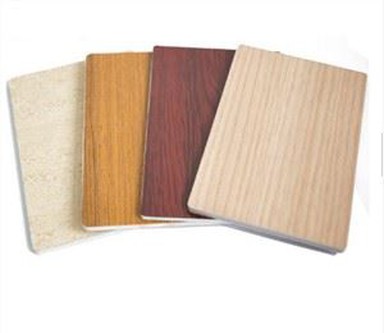
Fire-resistant aluminium plastic panels prepared for facade and interior cladding projects.

FR / B1 grade ACP with a mineral-filled core for mid-rise commercial facades.
7. Fabrication and Installation Differences
Mineral-filled cores are denser and less ductile than LDPE. In the workshop this means routing depth and bend radius must be validated on a sample from the production batch. Leave approximately 0.3 mm of core at the base of a V-groove, avoid cutting into the outer aluminium skin, use corner reinforcement angles on cassettes, and never re-bend a folded edge. Where a smooth curve is needed, cold roll bending without grooving is preferred, respecting a minimum radius of roughly 10–15 times panel thickness for PE-core grades; A2 grades often need larger radii and manufacturer approval.
On site, protect the core. Seal cut edges of mineral-core panels with a compatible silicone or polyisobutylene sealant so moisture cannot wick into the filler and reduce peel strength over time. Provide 5–8 mm expansion joints, slotted holes or sliding fixings to accommodate thermal movement, and use gasketed dry-seal rainscreen principles where dirt streaking from wet sealant would be visible. Store panels flat in a dry, ventilated area, keep the protective film on through fabrication, and remove it within about 45 days of installation. Clean the facade at least annually with a neutral detergent that has been compatibility-tested against the coating.
8. How to Verify Certificates and Traceability
A documentation pack for a fire rated ACP order should contain: a reaction-to-fire classification report naming the exact product (skin thickness, core type, coating, colour range, panel thickness); a Declaration of Performance or CE documentation where applicable; SGS, CTC or equivalent third-party test reports; fire-resistant test reports for the ordered configuration; a coating warranty if PVDF is specified; peel strength, flatness and impact test data; and a batch or lot number traceable to the production date and aluminium coil lot. Reports issued for a "generic ACP category" or for a different core are not evidence for your order.
Shandong Jixiang was founded in September 2003 in Tanyi Industrial Zone, Fei County, Linyi City, Shandong Province, China, and holds CE, SGS and CTC documentation together with fire-resistant test reports. The factory operates fully automatic continuous hot-laminating lines, two automatic fluorocarbon spraying lines and more than 70 sets of sheet-metal equipment, with annual output of about 6 million m² and a team of roughly 300 people. That in-house control is what makes it possible to issue a test report that corresponds to the panels actually loaded into the container, rather than to a sample made years earlier on a different line.
9. Price Drivers and Factory-Direct Procurement
Fire-rated ACP pricing follows four variables: mineral filler content (A2 costs more than FR, FR more than LDPE), aluminium skin thickness and alloy, coating system (PVDF above PE, three-coat metallic above two-coat solid), and order quantity plus sheet size customisation. Certification and third-party testing are a real cost, so a quotation dramatically below the market average usually signals a diluted core or a certificate that does not match the product. Ask for the pricelist broken down by core grade and skin thickness, and compare like with like.
For wholesale buyers, distributors and facade contractors, buying factory-direct from a China fireproof ACP manufacturer removes one margin and shortens the technical loop: the same team that answers the EN 13501-1 question controls the laminating line. Jixiang supplies OEM branding, custom colours, custom widths and special sizes, and exports to Europe, South America, the Middle East and Africa. To buy, send the building type, height, required classification, core grade, coating, panel thickness, quantity and destination port; the factory can then return a specification-matched quotation, sample cards and a production schedule rather than a generic per-sheet price.
10. Frequently Asked Questions
Is a fireproof aluminum composite panel really non-combustible?
Only A2-grade ACP approaches non-combustibility, with over 90% inorganic core content and classifications such as EN 13501-1 A2-s1, d0. FR / B1 panels are fire-retardant rather than non-combustible: they resist ignition and limit flame spread but still contain polymer binder. Neither term removes the need for a compliant wall assembly.
What is the difference between FR, B1 and A2 ACP?
FR is the generic trade term for a mineral-filled fire-retardant core (about 70% filler); B1 is a Chinese GB 8624 classification commonly used for the same performance tier; A2 is the higher European EN 13501-1 class requiring over 90% inorganic content. They are related but not interchangeable, because each belongs to a different classification system.
Does ASTM E84 Class A allow the panel on a high-rise facade?
No. ASTM E84 measures flame spread on the material surface. For exterior walls above the local height threshold, the entire assembly must pass a test such as NFPA 285, BS 8414 or AS 5113, with the same insulation, cavity barriers and fixings that will be installed. Always verify the assembly report.
Can fire-rated ACP be folded into cassettes?
FR grades generally can, using controlled V-groove routing that leaves about 0.3 mm of core. A2 grades are stiffer and many are unsuitable for tight 90° returns; larger radii, cold roll bending or an alternative fixing system may be required. Validate on a sample from the exact production batch before cutting the full order.
Which documents should a China ACP supplier provide?
Request an EN 13501-1 or GB 8624 classification for the exact panel, third-party SGS / CTC or equivalent reports, fire-resistant test reports, a CE Declaration of Performance where relevant, a coating warranty for PVDF systems, and batch traceability. Jixiang supplies CE, SGS and CTC documentation and fire-resistant test reports on request.
How much more does fireproof ACP cost and can I buy wholesale?
Cost rises with mineral content, skin thickness and coating grade. The premium is small compared with the cost of a non-compliant facade replacement. Jixiang offers factory-direct wholesale pricing, a specification-based pricelist, OEM branding and custom sizes for container orders; contact vip001@alu-fame.com or +86 157 3731 7522 with your core grade and quantity.
11. About the Manufacturer
Shandong Jixiang Decoration and Building Material Co., Ltd. is a China aluminum composite panel manufacturer, supplier and factory based in Tanyi Industrial Zone, Fei County, Linyi City, Shandong Province, China. Founded in 2003, the company specialises in the research and production of ACP and related decorative building materials, with more than 20 years of team experience, about 300 staff and annual output of roughly 6 million m². Products are exported to Europe, South America, the Middle East and Africa, and customisation requests are accepted for colours, sizes, cores and OEM branding.
2003
Founded in Shandong, China
6M m²
Annual decorative material output
CE / SGS / CTC
Documentation and fire test reports
4 regions
Europe, South America, Middle East, Africa
Explore the complete Aluminum Composite Panel category, request a sample card from the contact page, or review the company's factory tour and certificates.
Need a fire-rated panel with documents that match your exact build-up?
Learn about our production and testing capability, or watch the factory and packaging process before you place a container order.