
Aluminum Composite Panel Finishes: A Specifier's Guide To Brushed, Mirror, Wooden, Granite, Pearl And Metallic ACP
Nov 20, 2026
Aluminum composite panel finishes are decorative surface systems applied to the aluminium skins of an ACP sheet: solid and glossy polyester colours, metallic and pearlescent pigment systems, wood-grain and stone-grain transfer prints, brushed mechanical textures and mirror-polished surfaces. The finish determines appearance; the underlying coating chemistry (70% PVDF or PE polyester) determines how long that appearance survives outdoors. Jixiang manufactures fifteen core ACP product lines spanning both dimensions, so the same visual language can be specified for an exterior curtain wall, a retail interior and a signage package.
Key Takeaways
Finish and coating are separate
Wooden, granite, metallic and pearl looks exist in both PE and PVDF versions. Choose the look first, then the exposure-rated chemistry.
Three-coat for effect pigments
Metallic and pearl finishes need a clear topcoat outdoors to protect aluminium flakes and interference mica pigments.
Directionality is real
Roller-coated finishes reflect light differently by orientation. Install every panel on one elevation with the film arrows aligned.
Specialities need care
Brushed and mirror ACP are premium surfaces; protect them with film, gentle handling and compatible neutral cleaners.
Pattern scale matters
Wood and stone grains should be reviewed on a full-size sample card, not a 50 mm chip, before a facade is released.
One batch per elevation
Batch control, sample approval and factory-direct colour matching are the cheapest insurance against visible banding.
In This Guide
- How ACP finishes are manufactured
- Finish family map of the Jixiang range
- Solid and glossy PE finishes
- Metallic and pearl pigment systems
- Wooden and granite / marble finishes
- Brushed and mirror speciality surfaces
- Interior vs exterior: pairing finish with coating
- Colour consistency and installation direction
- Applications by sector
- Custom colour, OEM and buying guide
- Frequently asked questions
1. How ACP Finishes Are Manufactured
Most ACP finishes begin on a coil-coating line. Aluminium coil is cleaned, pretreated with a chromate or chrome-free conversion layer, primed, then roller-coated with one or more colour coats and oven-cured. A standard two-coat solid system is primer plus topcoat, around 25 μm dry film for PVDF. Metallic, pearlescent and some high-chroma colours use a three-coat system - primer, base colour coat and a clear protective topcoat - at 35 μm or more. The cured coil is then laminated to the core on a continuous hot-press line under controlled heat and pressure, and a peelable protective film is applied.
Decorative effects are added in three ways. Pigment technology produces solid, metallic (aluminium flake) and pearl (mica or interference pigment) colours, whose appearance changes with viewing angle. Transfer or printing processes reproduce wood grain and stone veining with repeatable patterns, which is how wooden and granite ACP are made without using timber or natural stone. Mechanical or surface treatment produces the linear texture of brushed ACP and the reflective surface of mirror ACP. Each route has a different cost, a different minimum order quantity and a different tolerance for outdoor exposure.
Because roller coating is directional, the finish carries a subtle grain orientation. This is invisible on a single sample and obvious on a 30 m elevation where half the panels were rotated 90°. Professional specifications therefore include three controls: sample approval under natural daylight, one production batch per elevation, and installation with all protective-film arrows pointing the same way. Shandong Jixiang Decoration and Building Material Co., Ltd. operates its own automatic fluorocarbon spraying lines alongside its laminating lines, which keeps colour matching, batch records and production direction under one roof.

Colour and finish development starts on the coating line - solid, metallic, pearl, wood and stone effects all originate here.
2. Finish Family Map of the Jixiang Range
| Finish family | PE / decorative lines | PVDF / exterior lines | Best-fit application |
|---|---|---|---|
| Solid colour | Solid Color PE ACP | Solid PVDF ACP | Corporate facades, walls, partitions, RAL programmes |
| High gloss | Glossy Color PE Coating ACP | Pearl and metallic PVDF with clear coat | Retail shopfronts, display, signage, interiors |
| Metallic | Metallic PE ACP | Metallic Color PVDF ACP | Canopies, feature bands, brand colours |
| Pearl | Pearl Color Aluminum Plastic Panel | Pearl Color PVDF ACP | Hospitality, flagship retail, luxury interiors |
| Wood grain | Wooden Color PE ACP | Wooden Color PVDF ACP | Soffits, interiors, feature walls, hospitality |
| Stone / granite | Granite Color PE ACP | Granite Color PVDF ACP | Lobbies, column cladding, plinths, facades |
| Mechanical texture | Brushed Aluminum Composite Panel | Brushed with protective clear coat on request | Lift lobbies, signage, interior feature walls |
| Reflective | Mirror ACP Wall Cladding | Protective grades for sheltered areas | Retail interiors, ceilings, display, signage |
| Fire-rated | Fireproof Aluminum Composite Panel in FR / A2 core with PE or PVDF finish | High-rise, transport, hospitals, schools | |
Table 1 - The fifteen core ACP product lines grouped by finish family, with the coating choice shown alongside the decorative effect.
3. Solid and Glossy PE Finishes
Solid colour ACP is the volume product of the category. Produced to RAL, Pantone or a customer sample, it gives a flat, uniform surface at the lowest cost per square metre and with the widest availability in 3 mm and 4 mm, 1220 × 2440 mm sheets. Solid Color PE Aluminum Composite Panel is the default for interior wall lining, partitions, ceilings, signage blanks and advertising boards; Solid PVDF Coating Aluminum Composite Panel is the exterior counterpart for curtain walls and rainscreen facades where a 15–20 year colour warranty is required.
Glossy Color PE Coating ACP pushes surface reflectance close to a polished appearance, which is why it is popular for shopfront fascias, vehicle graphics, exhibition stands and display panels. High gloss also reveals every imperfection: it needs flat substrates, careful handling, a strict flatness tolerance (≤0.5 mm/m where raking light hits) and a clean installation environment. For permanent outdoor exposure, discuss a clear-coated PVDF alternative, because standard polyester gloss will chalk and lose reflectivity under sustained UV.
4. Metallic and Pearl Pigment Systems
Metallic ACP uses fine aluminium flakes suspended in the colour coat. As the viewing angle changes, the flakes reflect more or less light, producing the silver, champagne, bronze or gold effect that architects use for horizontal bands, canopies and brand-identifying elevations. Metallic PE Coating Aluminum Composite Panel is an economical interior and signage choice; Metallic Color PVDF Coating Aluminum Composite Panel adds the fluoropolymer chemistry and clear topcoat needed outdoors.
Pearlescent finishes use mica or interference pigments instead of, or alongside, metal flakes. The colour shifts subtly between highlight and shade - champagne to pale gold, silver-white to soft blue - which reads as depth rather than shine. Pearl Color PVDF Coating Aluminum Composite Panel is specified for hotel and flagship facades; Pearl Color Aluminum Plastic Panel covers luxury interiors, trailer sides and decorative retail work. Both families are strongly directional, so a single rotated cassette will show as a visible colour patch. Approve a large sample, mark the direction on the shop drawings and keep all panels from one batch on one elevation.
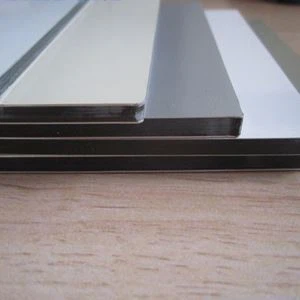
Pearl white ACP: interference pigments create angle-dependent depth for hospitality interiors.

Gold metallic PVDF ACP with a clear topcoat for exterior durability.
5. Wooden and Granite / Marble Finishes
Wood and stone looks solve a common design problem: the warmth of timber or the mass of stone without the weight, the maintenance, the weathering or the combustibility. Wooden Color PE Coating Aluminum Composite Panel and Wooden Color PVDF Coating Aluminum Composite Panel reproduce teak, oak, walnut and custom grains for soffits, feature walls, ceilings and hospitality interiors. The PVDF version is the one to use where the panels see real sunlight, for example on an external canopy soffit or a balcony lining.
Granite Color PE Coating Aluminum Composite Panel and Granite Color PVDF Coating Aluminum Composite Panel deliver marble veining and stone speckles for lobbies, column casings, plinths and full facades. A 4 mm granite ACP panel weighs a small fraction of natural stone, needs no anchoring for heavy loads and can be folded into cassettes. Pattern repeat is the practical concern: always review a full-size 300 × 300 mm or larger sample, agree the grain direction and the repeat, and reserve enough panels from one production run to complete every visible elevation.

Wooden series ACP - timber warmth with the flatness and light weight of a composite panel.

Stone-grain ACP for plinths, lobbies and column cladding.
6. Brushed and Mirror Speciality Surfaces
Brushed Aluminum Composite Panel carries a fine linear texture created by mechanical treatment of the aluminium skin, giving a satin, engineered-metal look that hides fingerprints better than a polished surface. It is widely used in lift lobbies, reception desks, retail fixtures and signage, and it pairs well with metallic and pearl colours in a coordinated palette. Mirror Aluminum Composite Panel Wall Cladding offers a highly reflective silver or gold surface for interiors, ceilings and display work, producing a sense of space at a fraction of the weight and breakage risk of glass mirror.
Both surfaces demand discipline on site. Keep the protective film on through cutting, routing and fixing; use clean gloves and flat storage; avoid abrasive cleaners and solvents; and specify a flatness tolerance that prevents waviness from showing under raking light. For exterior or high-traffic use, ask for a protective clear coat and a written cleaning recommendation. Where the project also has a fire requirement, discuss a mineral-core version early, because the surface treatment and the core grade are independent choices that must both appear on the purchase order.

Brushed ACP - a directional satin texture for interiors and signage.

Mirror ACP wall cladding in silver and gold tones.
7. Interior vs Exterior: Pairing Finish With Coating
| Project condition | Recommended finish and coating | Reason |
|---|---|---|
| Interior wall, lobby, partition, ceiling | PE solid, glossy, wooden, granite, brushed, mirror, pearl | No UV load; widest colour range at the lowest cost |
| Signage, exhibition, short-cycle retail | PE solid, glossy, metallic, UV-printable ACP | Strong printability and economy on a 3–5 year replacement cycle |
| Exterior facade, curtain wall, canopy | PVDF solid, metallic, pearl, wooden, granite, three-coat where needed | AAMA 2605 weathering and 15–20 year colour retention |
| High-rise or public building facade | PVDF finish over FR or A2 mineral core | Fire classification comes from the core, not the finish |
| Coastal, high-UV or industrial site | 70% PVDF, 0.40–0.50 mm skins, sealed edges | Salt spray, UV and pollution resistance over decades |
Table 2 - A finish can be beautiful in the wrong chemistry. Confirm exposure, height and local fire code before fixing the specification.
8. Colour Consistency, Samples and Installation Direction
Colour variation is the most common aesthetic complaint on ACP projects, and it is almost always a batch or orientation problem rather than a coating defect. Control it in four steps. First, approve physical sample cards under natural daylight, not a screen rendering, and keep a signed reference set on site. Second, order enough material from one production run to finish each elevation, including spare cassettes for future replacement. Third, label and store panels by batch number and install batch-by-elevation. Fourth, align all film arrows so the roller-coating direction is identical across the facade.
The same discipline applies to wood and stone patterns: agree the grain direction, the repeat length and the cassette layout on the shop drawings before cutting. For folded cassettes, remember that a grain running across a return leg will read differently from one running down it. Finally, remove the protective film within about 45 days of installation and clean the facade at least once a year with a neutral detergent that has been tested for compatibility with the coating. These habits protect brushed, mirror, pearl and high-gloss surfaces in particular.
9. Applications by Sector
Retail and hospitality. Pearl, mirror and high-gloss finishes create premium interiors; matching PVDF solid or metallic panels carry the brand colour onto the exterior. Corporate and institutional. Solid PVDF in light, UV-stable colours dominates, with granite or wooden finishes at the plinth and entrance to add warmth. Transport and public infrastructure. Brushed and fire-rated ACP are common in stations and airports, where cleanability, vandal resistance and a documented fire classification matter more than exotic colour.
Advertising and signage. PE solid, glossy and UV-printable ACP sheets remain the standard for boards, fascias and display systems, while the wider Advertising Aluminum Composite Panel range covers digital printing and heat-transfer work. Interior ceilings and building materials. Where a project also needs ceiling systems, curtain wall elements or honeycomb panels, Jixiang supplies matching Aluminum Ceiling and Aluminum Panel ranges, which makes coordinated colour control across packages much easier.
10. Custom Colour, OEM and How to Buy
Finish pricing is driven by the number of coats, the pigment system, the core grade and the order size. Solid two-coat PE is the entry point; three-coat metallic, pearl and printed wood or stone finishes add cost; PVDF chemistry, FR or A2 cores and thicker aluminium skins add more. Custom colour matching (RAL, Pantone or a physical sample), custom widths, non-standard lengths and small-batch production also carry setup charges. Request a pricelist that states all four variables - finish, coating, skin thickness and core - otherwise quotes are not comparable.
As a China aluminum composite panel manufacturer, supplier and factory with about 6 million m² annual capacity, Shandong Jixiang accepts OEM branding, custom colours, special sizes and special requests, and exports to Europe, South America, the Middle East and Africa. Distributors, facade contractors and design studios typically start with a sample card set, then place a trial order for one elevation before releasing the full container. To buy wholesale, send the finish name, the intended exposure, panel thickness, quantity and destination port; the team will return a specification-matched quotation and production schedule.
11. Frequently Asked Questions
What is the difference between wooden PE and wooden PVDF ACP?
The wood-grain pattern can be identical; the difference is the resin protecting it. Wooden Color PE ACP is intended for interiors and sheltered areas, while Wooden Color PVDF Coating ACP carries a fluoropolymer topcoat with 15–20 year exterior colour retention. Use PVDF wherever the panels see sustained sunlight.
Can mirror or brushed ACP be used on an exterior facade?
They are primarily interior and signage surfaces. Exterior use is possible in sheltered positions with a protective clear coat, a written maintenance plan and careful flatness control, but reflective surfaces show waviness and scratches readily. For a full facade, a metallic or pearl PVDF finish is usually the safer specification.
Why do some ACP panels look like a different colour on the same wall?
Roller-coated finishes are directional, and pigments vary slightly between production batches. Rotated panels or mixed batches produce visible banding, especially with metallic and pearl colours. Keep one batch per elevation, align the protective-film arrows and approve samples in natural daylight.
Which ACP finish is best for a shopfront or advertising board?
Glossy Color PE Coating ACP and Solid Color PE ACP are the usual choices because they are economical, printable and easy to fabricate. UV-printable sheets from the advertising range are used for digitally printed graphics. If the sign will be permanently sun-exposed for many years, ask for a PVDF-based alternative.
Can I order a custom RAL or Pantone colour and my own brand packaging?
Yes. Jixiang supports RAL, Pantone and physical-sample colour matching, OEM branding, custom sheet widths and lengths, and special thicknesses. Custom colours require an approved sample before mass production and are produced in one batch wherever possible to guarantee consistency.
Which finish should be paired with a fire-rated core?
Any of them, in principle. The Fireproof Aluminum Composite Panel line combines FR or A2 mineral cores with PE or PVDF finishes, so a granite lobby cladding or a pearl facade can still meet the required fire classification. Confirm that the test report covers the exact core and build-up.
12. About the Manufacturer
Shandong Jixiang Decoration and Building Material Co., Ltd. is a professional China aluminum composite panel manufacturer and supplier founded in September 2003, located in Tanyi Industrial Zone, Fei County, Linyi City, Shandong Province, China. With fully automatic continuous hot-laminating lines, automatic fluorocarbon spraying lines, more than 70 sets of sheet-metal equipment, roughly 300 staff and annual output of about 6 million m², the company supplies ACP, advertising ACP, aluminium ceiling and aluminium panel products to Europe, South America, the Middle East and Africa. CE, SGS and CTC documentation and fire-resistant test reports are available on request.
15
Core ACP finish lines
PE + PVDF
Both coating chemistries available
2003
Factory established in Shandong
OEM
Custom colour, size and branding
Browse the full Aluminum Composite Panel category or request a finish sample card via vip001@alu-fame.com and +86 157 3731 7522.
Want to see the finishes and the line that makes them?
Review our factory capability and certificates, or watch the production and packaging process in the video centre.
You Might Also Like
-

Fireproof Decoration ACP Sheet Aluminum Composite Panel W...
-

Building Material ACM Pearl Color ACP Panel
-

Metallic Brushed External Cladding Or Facades Of Building
-

PVDF ACP/aluminium Composite Sheets/composite Panel Cladding
-

Decorative Mirror Anodized Aluminum Composite Panel ACP S...
-

Signage Board Brushed Aluminium Composite Sheet